Water Leak Detection When the Source Is Unclear in Tucson, AZ
You have a wet spot on a wall, a damp floor, or a water bill that keeps climbing, and you do not know where the water is coming from. Quick Restore of Tucson arranges water leak detection in Tucson, AZ for homes and businesses through a leak detection partner, and our own team handles the water damage that comes with it. The partner locates where the water is coming from. We measure how far it has spread, remove pooled water, and dry the materials. A licensed plumber repairs the leak itself.
Finding the source matters for two reasons. It tells the plumber where to work, and it tells us how far the water has spread. Drying a wall while a pipe keeps feeding it only starts the problem over.
Call (520) 488-6759 and tell us what you are seeing. We offer 24/7 emergency service, and every emergency reaches a live team member, day or night. We dispatch right away and give you a realistic arrival estimate. If water is running and you cannot stop it, call us now and read the rest later.
Gather Leak Clues Without Assuming a Cause
A stain tells you something is wrong. It does not tell you what. Dampness and stains can come from a supply line, a drain, an appliance, a roof, or condensation, and more than one cause can be at work at the same time. So we start with questions instead of conclusions.
When you call, we will ask about:
- Where the damp spot or stain is, and how long you have noticed it
- Whether water is running right now
- Whether your water use has gone up, or whether the water meter moves when every fixture is off
- Which fixtures and appliances are near the area
- What changed recently, such as a repair, a heavy storm, or a new appliance
Some of these clues you can check yourself. Turn off everything that uses water, then look at your water meter. If the dial or the reading moves while nothing is running, water is going somewhere. That does not tell you where, but it is a useful fact to tell us. A bill that rises with no change in how you use water points the same way.
A clue is a place to start looking, not a finding. We treat what you tell us as a lead, check the wet areas on site, and pass what we find to the leak detection partner.
Investigate the Suspected Source and Access
Two jobs happen here, and different people do them. Our team maps the moisture: a thermal camera shows warmer and cooler areas on a surface, and moisture meters tell us whether the material behind that surface is actually wet. Together they show where water has been and where it is gathering. Locating the leak itself is the leak detection partner's work. A typical visit goes like this:
- We talk through the clues and walk the affected area with you.
- We scan walls, ceilings, and floors with the thermal camera, check the unusual patterns with moisture meters, and record the readings.
- If the source is not obvious, we arrange for our leak detection partner to locate it, and we share our readings with them.
- A licensed plumber repairs the failed pipe, valve, or fixture.
- We dry the wet materials and keep taking readings until they are dry.
No single tool finds every hidden leak. A thermal image shows a surface pattern, and it does not show a pipe inside a wall. Readings tell us where materials are wet, and that can narrow the search a long way, but some leaks cannot be pinpointed without opening a wall, a ceiling, or a floor. When that is the case we say so, explain what opening the area would involve, and ask before anything is opened.
Many Greater Tucson homes are stucco, some adobe-style, built on slab foundations. Moisture can move through stucco and under flooring without much showing on the surface, and dry desert air can make a wet area feel dry to the touch. We rely on readings instead of how a wall looks or feels.
Keep Source Repair Separate From Damage Recovery
Finding a leak, fixing it, and drying what it soaked are three different jobs. We want you to know exactly where each one starts and stops.
Our part is the water damage. We measure how far the moisture has traveled, remove pooled water, check what is still wet, and dry the materials. Locating the leak is done by the leak detection partner we arrange. A licensed plumber repairs the failed pipe, valve, or fixture. If the leak is in an appliance, the repair belongs to an appliance technician. We do not do plumbing repair.
This matters because the order is important. If a pipe is still leaking, drying only buys time. If the pipe is fixed and the wall is left wet, the water that already soaked in stays there and can cause trouble later. The work should be done in order: find the source, repair it, then dry the damage. Ask whoever repairs the leak to tell you when the source is stopped, so the drying can start with a clear picture.
We document what we find with photos and moisture readings. Those records help whoever repairs the leak, and they help you explain the loss to your adjuster. We work with all major insurance carriers, and we can communicate with your adjuster about what we documented.
Escalate Suspected Slab or Buried-Line Leaks
Some leaks are not in the walls at all. Many Greater Tucson homes sit on slab foundations, and supply lines can run beneath the slab. Other lines run underground between the street, the meter, and the house.
These are the signs that make us think a leak may be below the floor or outside the building:
- A warm or damp spot on a floor with no stain above it
- Flooring that lifts, buckles, or feels damp near an exterior wall
- Soggy or sunken ground along the path of a water line
- A water meter that keeps moving even though nothing in the house is running
Moisture readings and thermal imaging can show where water is surfacing or collecting. They do not locate a pipe under a slab or under the ground, and a surface clue is not a reliable way to name the exact spot. For those leaks, a licensed plumber or a specialist who works on slab and underground lines should take the next step. We do not prescribe breaking into a slab or digging up a yard from a surface clue, and we do not claim to pinpoint a buried line.
If the leak has already wet your floors or walls, we assess the water damage. Tell us what you are seeing, and we will say whether the next step is our leak detection partner, a plumber, or both.
Plan the Restoration Handoff After Source Control
Once the leak source has been dealt with, the focus moves to what the water did. This is the restoration handoff, and it covers three things.
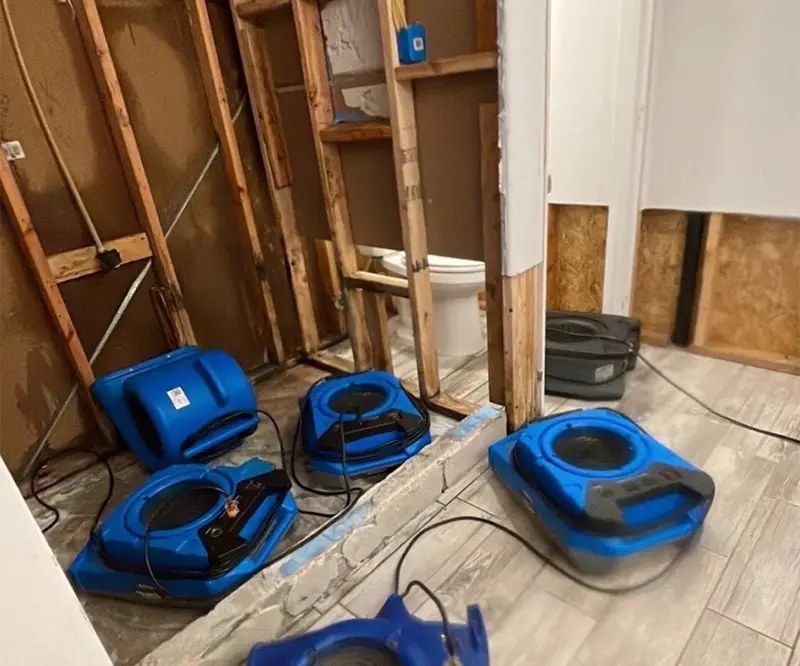
First, we assess the materials. We read moisture levels in flooring, the bottoms of walls, cabinets, and any other areas the water reached. Second, if water is pooled on a floor, we remove it through our water damage restoration work. Third, if materials remain wet, we dry them and check the readings until they have dried.
Fixing the leak does not dry the property. Water that soaked into subfloors, drywall, insulation, and framing stays there until it is dried out, and appearance is a poor guide. We take readings, set up the drying, and tell you what we find. Drying takes days, and sometimes longer, and the time depends on the materials and the conditions. We will not give you a fixed drying time.
If materials are too damaged to dry, we explain which ones and why before they are taken out. We are a licensed Arizona contractor (ROC 345010), and rebuilding follows once the area has dried.
Ask About Water Leak Detection in Tucson, AZ
Call (520) 488-6759 and tell us what you are dealing with. The details that help most:
- What clue you noticed and where it is
- Whether water is still running
- What your meter or your fixtures are telling you
- Which rooms or materials are already wet
- Anything that limits access, such as a locked room or a covered area
We will tell you plainly what we do, which is to map the moisture and handle the water damage, what our leak detection partner does, and what has to go to a plumber. We serve homes and businesses across Greater Tucson, and we are available 24/7, 365 days a year. Every emergency reaches a live team member, day or night.