Thermal Imaging Inspection to Investigate Suspected Moisture in Tucson, AZ
You see a stain on a ceiling, a soft spot in a floor, or a wall that feels cooler than the one beside it. You suspect moisture, but you cannot see where it starts or how far it goes. A thermal imaging inspection can help. Quick Restore of Tucson uses thermal imaging in Tucson, AZ to find areas worth checking, and then we confirm what is really wet with moisture meters.
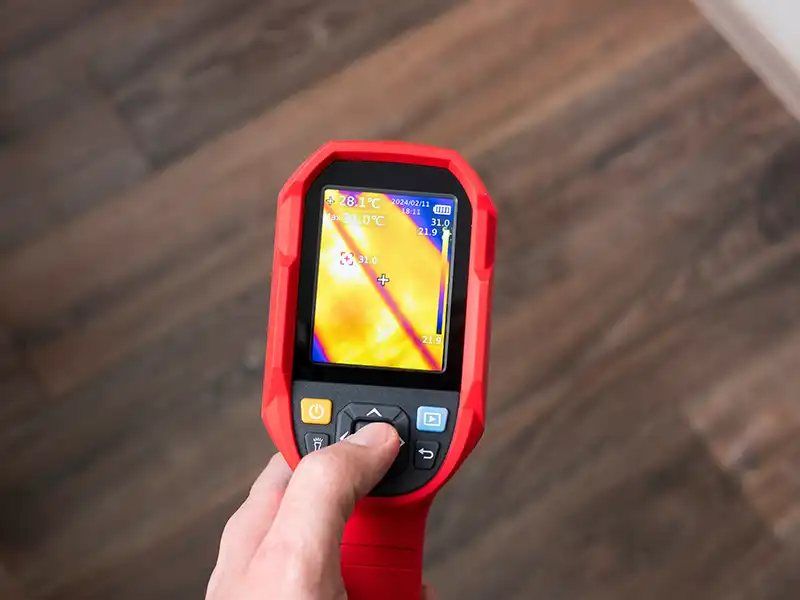
A thermal camera shows warmer and cooler areas on a surface. Those patterns can point to a spot where moisture may be sitting. But a pattern is not proof of water, and it is not proof of a leak. Different things cause the same pattern, including sun on a wall, a duct, or an air gap, so the camera only tells us where to look more closely.
If you want to talk through what you are seeing, call (520) 488-6759 or send us the details. If water is actively coming in, call right away. We offer 24/7 emergency service, and water damage restoration is the next step for active water.
When a Thermal Scan May Help
A scan is most useful when you have a symptom and want to know how far it goes. These are the situations where we are usually asked to look:
- An unexplained stain on a wall or ceiling
- A wall or floor near an area that had a known water event
- Flooring that feels soft, cool, or damp with no clear reason
- A question about whether an area is still wet after cleanup
A scan can guide where to check next. It is not a remote diagnosis, and it does not replace looking at the area in person. Many Greater Tucson homes are stucco, some adobe-style, on slab foundations, and water can travel inside stucco walls and under flooring on a slab without much showing on the surface. Dry desert air can make that even harder to judge by eye. A surface can feel dry while the material behind it stays wet.
When we look, we ask about access and recent conditions, because warmer and cooler areas have other causes. We want to know whether the air conditioning was running, whether the sun was on the wall, and what the room has been through lately. Those answers help us read a pattern correctly instead of jumping to a conclusion.
What the Camera Can—and Cannot—Establish
A thermal camera reads surface heat patterns. That is all it does, and the limits matter.
What a thermal image can do:
- Show where a surface is warmer or cooler than the area around it
- Point to an area that deserves a closer look
- Help us decide where to take moisture readings
What it cannot do:
- See through a wall, because it only reads the surface in front of it
- Measure moisture on its own
- Show that mold is present
- Name the source of a leak with certainty
That is why we do not stop at the image. A moisture meter or another appropriate check confirms whether a suspicious area is actually wet. The camera narrows down where to look, and the meter tells us whether the material holds moisture. If a pattern shows nothing wet when we check, we tell you that too.
If your main question is where a leak is coming from, water leak detection, which we arrange through a partner, is built around that question. A thermal image alone does not identify a specific pipe or fixture.
From Scanning to Confirmed Findings
The steps change from one property to the next, and we do not claim every property gets the same checklist. This is how a typical inspection goes:
- We listen to the property's history: what you have seen, when it started, and whether water has been involved.
- We agree on the areas we can reach and the rooms to include.
- We scan the relevant surfaces and note where the patterns show up.
- We check those spots with moisture meters and record what they read.
- We tell you what we found, what is still uncertain, and what we suggest next.
Review the affected areas first. We look at the stain or the event you described and the rooms around it, because moisture can travel from where it started. Check the findings next. Every pattern we flagged is checked against a reading, so a finding rests on a measurement and not on a color on a screen. Then we explain the next step in plain language, whether that is drying, a closer look at the source, or nothing at all.
We cannot promise to find all hidden damage. Some areas are not reachable without opening a wall or a floor, and we explain any such limit before we suggest opening anything. We will not open materials without your consent. If we find wet materials, our structural drying work is the usual next step.
Understanding Results and Next Steps
A scan can produce three different things, and it helps to keep them apart.
An anomaly is a pattern on a surface. It is a reason to check, not a finding. A measured material condition is what a moisture meter reads in a specific spot. That is a finding. A cause is the reason moisture is there, such as a failed supply line or water coming in from outside. A scan and a meter reading do not identify the cause on their own, and we tell you plainly when the cause is still unknown.
We explain what we found in person, and we keep the images and readings we took. Ask before the visit what you will receive, because we do not want you to expect a deliverable we have not agreed to. We do not tell you a property has no moisture or mold because a scan looked normal, and a scan does not provide a mold test or a clearance.
What happens next depends on the result:
- Wet materials: we set up drying and track the readings. We keep the same records we keep on any loss, with photos, moisture readings, and an itemized scope.
- A leak or failed fixture: a licensed plumber repairs it. Our scan does not repair water damage or the pipe behind it.
- Mold concerns: that needs a separate assessment based on what is found.
- Nothing wet: we tell you, and you have a clearer picture of what the stain was.
We work with all major insurance carriers, and we can communicate with your adjuster about what we documented. Coverage decisions belong to your insurance company.
Ask About Thermal Imaging Inspection in Tucson, AZ
Call (520) 488-6759 and tell us what you are trying to find out. These details help:
- What you saw, such as a stain, a soft spot, or a damp smell
- Where it is in the property
- Whether the area is easy to reach
- When you first noticed it and whether water has been involved
We will tell you whether a thermal scan makes sense for your situation, or whether a water damage assessment is the better first step. We serve homes and businesses across Greater Tucson. If water is running now, say so when you call. We are available 24/7, 365 days a year, and every emergency reaches a live team member, day or night.